Skip to content
Chad Mazzola

Posts by Chad Mazzola

Overhear

I built a MacOS menubar app called Overhear that lets you filter the audio on your computer so it sounds like it’s playing in a more nostalgic, ambient location.

I was inspired by two things: this YouTube video of Toto’s Africa playing “in an empty shopping centre” and this quote by Witold Gombrowicz:

To me, art almost always speaks more forcefully when it appears in an imperfect, accidental, and fragmentary way, somehow just signaling its presence, allowing one to feel it through the ineptitude of the interpretation. I prefer the Chopin that reaches me in the street from an open window to the Chopin served in great style from the concert stage.

Here’s a browser-based version so you can hear Chopin through an open window.

Grab the source on GitHub.

A bigger, better Beautiful Web Type

Beautiful Web Type showing the Bricolage Grotesque typeface

One of my earliest projects is also one of my most popular: Beautiful Web Type.

The original was built over one weekend in 2012, based on my hunch that there were high-quality open-source typefaces in Google Fonts, they just needed to be hunted down amidst the lower-quality ones.

The original version went to the top of Hacker News, got me a private email of praise from a famous type designer, and plenty of recruiting interest from Silicon Valley.

I did a refresh in 2018, but have mainly let it sit untouched since then. But over the weekend I decided to throw some time, love, and tokens at it. The result is a vastly improved site which should help you decide how a typeface actually looks in various settings and whether you’ll actually want to use it.

The year of not giving up

There were many times this past year when I regretted starting a company.

An email to friends and former colleagues asking for feedback would receive polite but distant replies. Or no reply at all. A stranger would subscribe and then cancel the next day. Someone at a party would ask, “Are you still working on your AI stock thing?” and I’d catch a note of condescension in their voice.

Everyone tells you that starting a company is ten times harder than it seems, but you don’t believe them until you experience it firsthand. You go to dark places in your mind. You feel totally alone. You try to remember why you started in the first place. You stumble forward, hoping the world will eventually bend in your favor.


The two most important books I read this year were Living an Examined Life by James Hollis and The Creative Act by Rick Rubin.

Hollis’s book, written from a Jungian perspective, is an appeal to live the second half of one’s life more authentically than the first. To do this, you have to put aside the weight of tradition, childhood demons, outdated self-beliefs, and aim towards the highest, truest version of yourself.

Rubin’s book is ostensibly about the spiritual and practical aspects of succeeding as an artist. But it can be read more broadly as a guide to living a life that’s true to your deepest sense of self, artist or otherwise. One doesn’t succeed by accident, but by setting up the conditions to consistently channel your experience, inspiration, and voice into something you can share with like-minded people.

Taken together, these books helped me see my struggle in a new, broader context. The reason I quit my job and started my own company was to pursue an authentic, self-chosen path, living wholeheartedly and in service to higher ideals. Living this way would be a success in itself.


At some point this year, I started listening to Bach on repeat. I’d have it in my headphones as I walked to the outdoor gym. Tucked next to the water, it’s one of my favorite places in Stockholm. In the late fall, I watched trees shedding their leaves and squirrels gathering acorns, and felt a deep, grand sense of peace. These moments, experienced with a quiet, untroubled mind, were among the most meaningful of the year.

With this mindset, I started to notice how the opinions of others and the noise of “the current thing” seemed less important. The online world, with it’s endless stream of opinions, propaganda, advertisements, ignorance, boasts, and hype called for only one response: indifference.

This clarity of mind helped me gain a renewed sense of purpose in my stupid little startup.

The main reason startups fail is that founders give up. But if you refuse to quit, you eventually run out of excuses. And then you see it: the primary obstacle is yourself.


During my mornings with Bach, amid falling autumn leaves, I often thought about a quote from Nietzshce:

…to do something and do it again, from morning till evening, and then to dream of it at night, and to think of nothing except doing this well, as well as I alone can do it. When one lives like that, one thing after another that simply does not belong to such a life drops off. Without hatred or aversion one sees this take its leave today and that tomorrow, like yellow leaves that any slight stirring of the air takes off a tree.

For 2026, I want only the freedom to spend another year doing the work.

Who Needs Foundations?

Cryptocurrency isn’t backed by precious metals or the guarantees of the state. Does it matter?

This question of foundations was a major concern for the philosopher Richard Rorty. He sought a new direction for philosophy, away from the belief that the truth of statements could only be judged by how well they correspond to a mind-independent reality. Rather, he saw philosophy — and social thought in general — as simply conversations we hold with each other as we invent new forms of shared understanding.

That is how I see cryptocurrency: an invention that facilitates new forms of social relations. It’s a highly contagious meme, a rapidly spreading social game, a complex system bootstrapping itself into ever more complex forms. Born from humanity, it now lives a semi-autonomous life.

I have no interest in making moral judgments about any of this. I look to John Gray here: technology evolves rapidly, but human nature does not keep pace. Technology doesn’t make us more or less moral. It simply enables new forms of expression.

There is no ultimate foundation to secure claims of truth and value, whether we are speaking of philosophy or bitcoin. In this gap lives our freedom to invent.

Dick jokes

I.

For some reason, I started reading the book Penis Envy and Other Bad Feelings by critical theory professor Mari Ruti.

In the opening pages, she describes a scene from her childhood in Finland (this scene takes place in a sauna, of course), where she spots her father’s shriveled penis and asks if he’s going to die from the tumor between his legs. In her telling, she's never been able to “take the organ too seriously” after this encounter.

She connects this childhood experience (you call that a penis?) to Lacan’s claim that “phallic authority is always a masquerade”. This masquerade plays on the fantasy within the social imagination of the powerful male, in possession of a member that would make Tom of Finland blush, who wields power that cannot be challenged. Look upon my johnson and despair.

Of course this fantasy is just that. It conceals the truth that all humans are weak, fallible and lacking, phallus or no phallus.

II.

I recently went looking for a short story I recalled reading in my late teens. After some research, it seems that in my memory I had combined elements of two different stories by Kafka, “Before the Law” and “An Imperial Message”, then added my own twist.

In any case, my misremembered story still feels like something Kafka could have written. The rough outline is this:

A man is given an important message to deliver to the king of a distant kingdom. He travels day and night, finally arriving at the gates to the king’s castle. When he asks permission to enter, the guard tells him that no one is allowed in, not now or ever. The man pleads his case, citing the importance of his message, but the guard does not relent. The man waits years, until finally the guard dies, leaving the gates unattended. The man enters the castle, but finds it empty. After searching every room, he reaches the final door. He opens it to find an empty room of dust and cobwebs. The man sits down and weeps.

The guard is there not to protect the king, but to prevent the discovery that there is no king.

III.

So, to review: the phallus is powerless, the throne is empty, and god is dead. Like Nietzsche, we’ve now arrived at the problem of nihilism.

John Marmysz’s Laughing at Nothing is a useful guide to the landscape. He lays out what he calls the three basic assumptions of nihilism:

  1. Humans are alienated from such perfections as absolute Being, Truth, Goodness, Justice, Beauty, etc.;
  2. This circumstance of alienation is other than it ought to be;
  3. There is nothing that humans can do to change this circumstance.

The recognition that one has been longing after unattainable fantasies can be crushing. In the clichéd depiction, a nihilist is someone who does not recover from this insight. They spend their time loudly reminding those around them of the meaninglessness of existence, or live in a permanent state of rebellion, or lapse into quiet despair at the tragedy of the human condition.

But the central insight of Marmysz’s book is that one can accept the nihilist’s description of the world without becoming a “nihilist” in the popular sense. Referencing the work of Alan White, Marmysz describes “complete nihilism”:

Complete nihilism occurs when the radical nihilist stops regarding as worthwhile those traditional values that, in comparison, make the world of the here and now look bad. At this point, the world is re-enchanted and becomes valuable in and of itself. The complete nihilist is, in a sense, “beyond nihilism.” The longing for something better and more perfect is at an end on this last level. Nihilism has been completed and in this consummation “the complete nihilist, is no longer a nihilist.”

The post-nihilist is no longer disappointed by the difference between their imagined ideals and the world as it is. The nihilist-who-is-no-longer-a-nihilist is not forced into rebellion or despair, but is free to choose their own response. Like Seneca before him, Marmysz recommends laughter.

IV.

There’s a wonderful scene in the first season of True Detective, where Detective Rust Cohle visits Joel Theriot, a former revivalist preacher turned day-drunk. He tells Cohle what led him to leave behind preaching. The scene ends with Theriot saying, “All my life I wanted to be nearer to God. The only nearness? Silence.”

I imagine that young Mari Ruti, in different circumstances, might have laughed at the sight of her father’s shriveled penis rather than seeing it as a harbinger of his death. The messenger from my mis-remembered Kafka story could have sat in that empty castle and laughed at the absurdity of his situation.

Like an abandoned church that’s converted into a nightclub, the post-nihilist is free to create new meaning out of the wreckage of the past. You can take this radical freedom as far as you dare.


Endless forms most beautiful

Photo by Gian Paul Lozza

Photo by Gian Paul Lozza

There is grandeur in this view of life, … [that] from so simple a beginning endless forms most beautiful and most wonderful have been, and are being evolved.
— Charles Darwin, The Origin of Species

Cities are no more artificial than Bee-hives. The internet is as natural as a spider’s web. We ourselves are technological devices, invented by ancient bacterial communities as means of genetic survival — we are part of an intricate network that comes from the original takeover of the Earth. Our power and intelligence do not belong specifically to us, but to all life.
— John Gray, Straw Dogs

Both Darwin and Gray evoke the image of an unnamed, creative force that generates increasingly complex forms of order from chaos. Human intelligence was created by this force, and we are now a means for accelerating this play of creation.

This creative force has no concern for me, but I am its child. I am a finite being, but the endowment of consciousness has made me aware of my place within this infinite network of evolving forms.

I am aware of my eventual death, but I am consoled by the thought that I will have played a role, an infinitesimally small one, in the evolution of things I cannot imagine. I will not see all that comes after me, but I will have been a means for its arrival.

Humanity’s potential is worth preserving, he argues, not because we are so great now but because of the possibility, however small, that we are a bridge to something far greater.
— Toby Ord, quoted in The New Yorker

Recognizing my self as temporary, conditioned by events beyond my control, animated by forces beyond my awareness, I am but one strange aspect of a universe of endless invention.

Thus shall ye think of all this fleeting world:
A star at dawn, a bubble in a stream;
A flash of lightning in a summer cloud,
A flickering lamp, a phantom, and a dream.
— Diamond Sutra

Self as Process

I recently re-watched season one of True Detective, interested to take another look at the philosophy of Rust Cohle.

Nic Pizzolatto, the creator and writer of the show, has cited Thomas Ligotti’s book The Conspiracy Against the Human Race, as one inspiration for Cohle’s character. Ligotti's book argues that human consciousness is a burden too heavy to bear and that humans should voluntarily stop reproducing in order to end the inevitable suffering that comes with being born.

Cohle’s philosophical monologues make his debt to Ligotti clear:

I believe human consciousness is a tragic misstep in evolution. We became too self-aware. Nature created an aspect of nature separate from itself; we are creatures that should not exist by natural law… I think the honorable thing for our species to do is deny our programming, stop reproducing. Walk hand in hand into extinction. One last midnight, brothers and sisters, opting out of a raw deal.

Alongside the belief that consciousness is a burden too heavy to bear, Cohle also believes the self is an illusion. As Cohle puts it, people “labor under the illusion of having a self”, living “with total assurance that we are each somebody, when in fact everybody is nobody.”

While the belief that humankind should bring about its own extinction has few adherents, the claim that the self is an illusion is now in fashion amongst a group of philosophers and neuroscientists working on the study of consciousness.

Thomas Metzinger is one such philosopher. He writes: “no such things as selves exist in the world: Nobody ever had or was a self…” Or consider this passage from historian Peter Watson’s massive book on the history of ideas:

There is no inner self. Looking “in,” we have found nothing—nothing stable anyway, nothing enduring, nothing we can all agree upon, nothing conclusive—because there is nothing to find.

After reading these passages, I found myself asking: what could possibly count as a real self? What would it mean to be (in the words of Metzinger) a “whole and persisting entity”?

It seems to me that Metzinger and Watson, like Rust Cohle, are clinging to a Platonic-Christian idea of the self. What they are asking for could only be satisfied by some thing that survives the death of the physical body. In other words, a soul. Since the soul is nowhere to be found, they conclude that the self must not exist either.

Evan Thompson offers a way out from this line of thinking in a fantastic essay written in response to True Detective. No, the self is not a “whole and persisting entity”, but the self still exists. Countering the perspective he calls “neuro-nihilism”, Thompson writes:

The self isn’t a thing; it’s a process—one that enacts an “I” and in which the “I” is no different from the process itself, rather like the way dancing is a process that enacts a dance and in which the dance is no different from the dancing. From this “enactive” perspective, although meaning and the self have no absolute foundation, neither are they complete illusions or nonexistent; they’re brought forth in how we act and live our lives.

After reading Thompson's essay several times, I found myself thinking what seemed an obvious larger question: if the self doesn’t exist outside of process, time or change, then what does? A little research showed that many people have had the same thought.

Getting started with complexity science

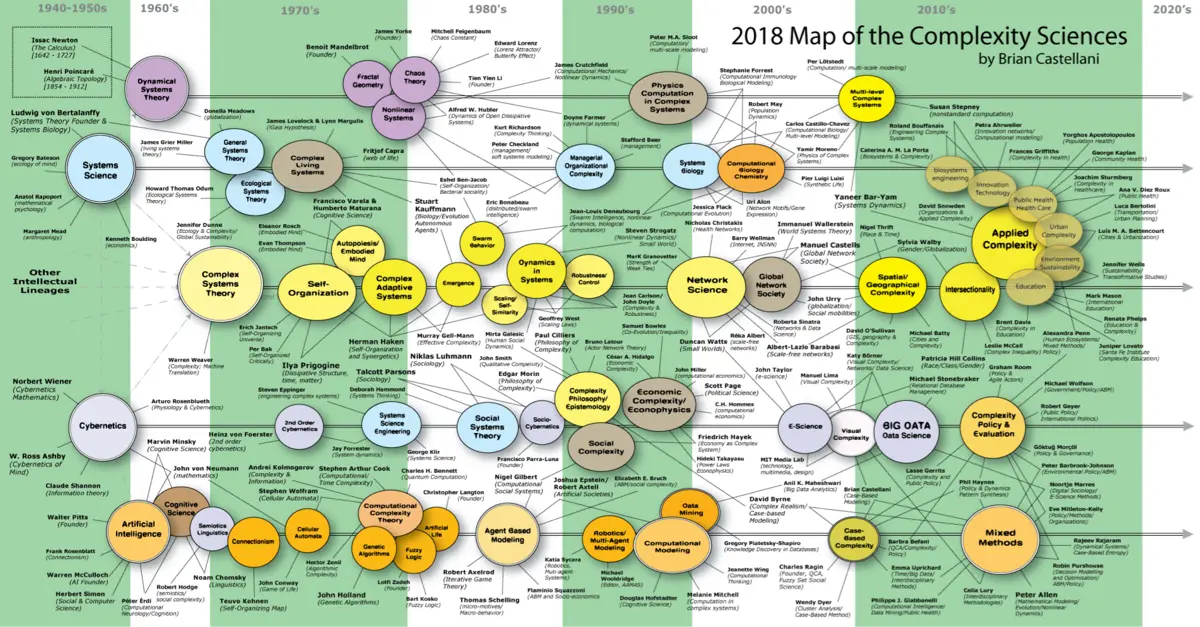
Over the past month I’ve been spending a big chunk of my time learning about complexity science. That term is broad and covers a number of areas, from chaos theory to artificial intelligence. The unifying perspective within the field, roughly speaking, is a focus on the emergence of unexpected system-level behavior due to the operation of simpler agents operating within the system. In essence, systems where the whole is more than the sum of the parts.

Members of the complexity science community often place their work in opposition to reductionism. For example, a blog post by the neurogeneticist Kevin Mitchell makes the case for the insufficiency of reductionism within biology:

The reductionist perspective on biology is that it all boils down to physics eventually. That anything that is happening in a living organism can be fully accounted for by an explanation at the level of matter in motion – atoms and molecules moving, exerting forces on each other, bumping into each other, exchanging energy with each other. And, from one vantage point, that is absolutely true – there’s no magic in there, no mystical vital essence – it’s clearly all physical stuff controlled by physical laws.

But that perspective does not provide a sufficient explanation of life. While living things obey the laws of physics, one cannot deduce either their existence or their behaviour from those laws alone. There are some other factors at work – higher-order principles of design and architecture of complex systems, especially ones that are either designed or evolved to produce purposeful behaviour.

As I’ve written about previously, it’s most certainly false to believe that “higher-level explanations cannot be fundamental”.

The field of complexity science is incredibly rich, with more than a hint of subversive energy running through it. Here is a sampling of online courses, books, and other resources to get started learning about this field.

Online Lectures & Courses

  • Introduction to Complexity: This free online course is offered by the Santa Fe Institute, the unofficial home for complexity science research. This course is taught by Melanie Mitchell, who also wrote the very good book Complexity: A Guided Tour, which covers a lot of the same territory. I finished this course a few weeks ago and highly recommend it as a first place to start learning about the field. It has a good mix of history, theory and hands-on practice using math and code.

  • Introduction to Dynamical Systems and Chaos: This free online course, also from the Santa Fe Institute, covers some of the same territory as the Introduction to Complexity course, but is more math focused. There are a number of mathematical ideas and formulas that come up again and again in the field, and this course gives a good introduction to a handful of them.

  • Journey into information theory: Information theory is another field that is heavily referenced within complexity science. This video series from Khan Academy is the most interesting, accessible intro to information theory I’ve found.

Books

  • Chaos: Making a New Science by James Gleick. Published in 1987, this book is often cited as the best place for a high-level overview of chaos theory and other ideas from complexity science.

  • Complexity: A Guided Tour by Melanie Mitchell. As mentioned above, this book covers much of the same territory as the Introduction to Complexity course, but the longer book format allows her to go into more detail on many of the subjects. It’s less journalistic than Gleick’s book and more focused on the actual science.

For more book recommendations, check out the list at the bottom of the blog post from Kevin Mitchell quoted above.

Code

  • The Nature of Code: This free book “focuses on the programming strategies and techniques behind computer simulations of natural systems”, with many ideas pulled from complexity science. The code examples from the book are available in either Processing or p5.js, the JavaScript port of processing.

  • Think Complexity 2: This free book explores some ideas from complexity science through Python code. I haven't had the chance to go through it yet, but I’ve read other books from Green Tea Press and was impressed with their quality, so I have high hopes.

Interactive tools

  • Complexity Explorables: a collection of interactive explorable explanations of complex systems in biology, physics, mathematics, social sciences, epidemiology, ecology and other fields.
  • Emergent Mind: a project-based blog about emergence, evolution, and artificial life.

Community

Finally, here are some members of the complexity science community with interesting online presences.

  • Kevin Mitchell: neurogeneticist interested in the genetics of brain wiring and its contribution to variation in human faculties.
  • Jessica Flack: Professor at the Santa Fe Institute.
  • Melanie Mitchell: AI researcher, professor and author.
  • Evan Thompson: I am in the midst of reading Evan’s book Mind in Life, where he uses ideas from complexity science to address the “so-called explanatory gap between biological life and consciousness”.

This is just a small sampling from this broad and growing field. As usual, I’m collecting more resources in a dedicated Are.na channel as well.

Technologies of the Self: A Short Introduction

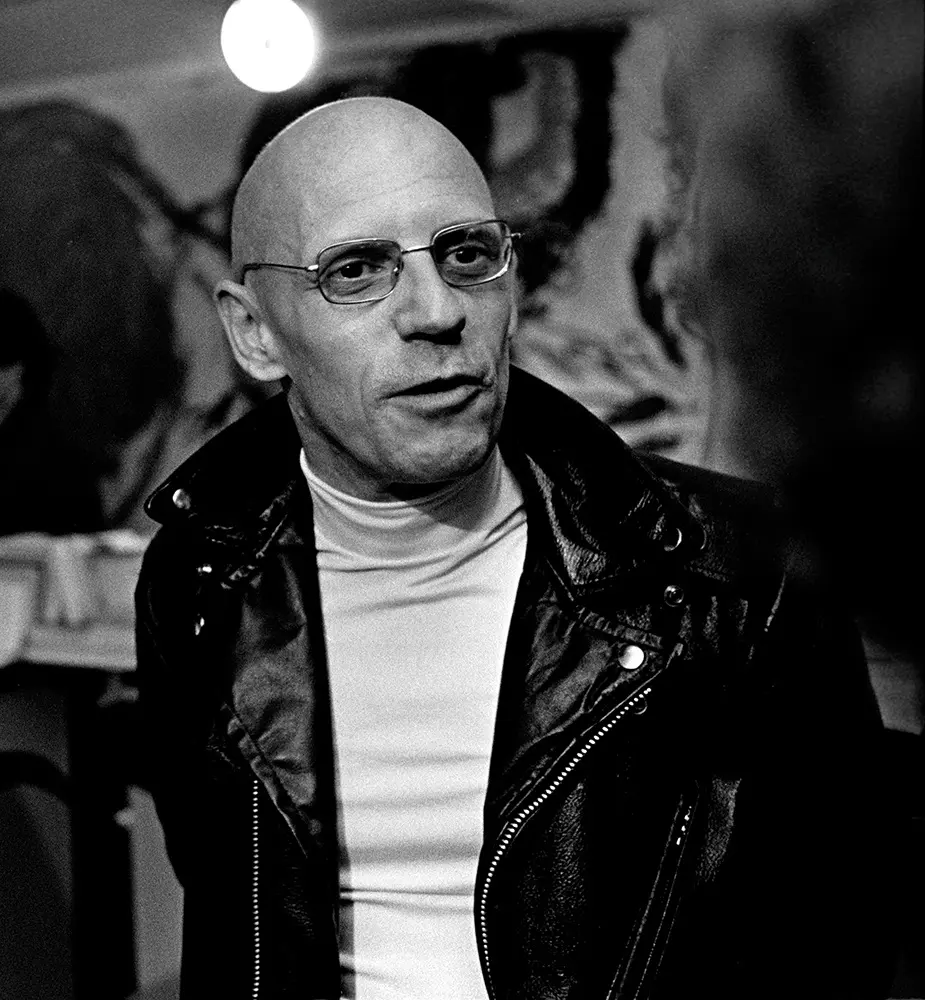
Speaking at a public lecture two years before his death, Michel Foucault introduced a new area of research which he called “technologies of the self”. Noting that he has “perhaps” focused “too much on the technology of domination and power”, Foucault says that he would now rather look at “how an individual acts upon himself.”

[T]echnologies of the self… permit individuals to effect by their own means or with the help of others a certain number of operations on their own bodies and souls, thoughts, conduct, and way of being, so as to transform themselves in order to attain a certain state of happiness, purity, wisdom, perfection, or immortality.

Michel Foucault

Following this definition, technologies of the self can be anything from reading, writing, exercise, and meditation, to plastic surgery, Instagram filters, and neural links. What makes Foucault’s framework so useful is that is allows one to look not only at individuals’ behaviors and aspirations, but the tools and practices they use to enact them, as well as the cultural contexts surrounding them.

I was brought back to Foucault’s work on this idea by Erik Davis’ amazing book, High Weirdness. Davis’ book recounts the psychedelic adventures of Terence McKenna, Robert Anton Wilson, and Philip K. Dick, weaving through and around their personal stories a larger narrative about media, psychology, and the limits of knowledge. Davis’ protagonists make use of their favored technologies of the self in order to do much of what Foucault sketched out in his initial formulation: attain a certain state of happiness, purity, wisdom, perfection and immortality.

I had a passing thought several years ago that if the zeitgeist of 1968 was “LSD and the Grateful Dead”, then 2018 was “modafinil and podcasts at 1.5x speed.” This tongue-in-cheek observation might serve as a useful entry point into several themes relevant to the study of technologies of the self.

I.

The particular operations a person can perform on themselves, the transformations they can entail, and the states of consciousness they can enable are countless. If we contrast the stereotyped “1968” experience — a cosmic consciousness free associating between disparate ideas, the boundaries of the self slipping away — and contrast it with “2018” — a hyper-focus on instrumental knowledge and achieving social and economic mastery through personal productivity — the yawning chasm between various modes of inner experience becomes apparent.

In both of these examples, we see the connection between technologies (synthesized drugs and recorded media) and the beliefs their users bring to bear on them. In turn, these individual practices are embedded within a set of cultural beliefs and traditions that create a framing for the experience.

None of that matters, though, for the person caught in the here-and-now of a technology they hope can transform their body or soul. They want to proclaim the truth of their experience and hasten the transformation. Davis’ description of Terence and Dennis McKenna’s struggles to square their belief in scientific naturalism with the received truth of their psychedelic experiences highlights precisely this dynamic.

Is it possible to suspend belief about whether a particular technology reveals something “true” and instead focus on what it has to tell us about the nature of human experience and the possibilities for personal change? I think so.

II.

Three interconnected claims: (a) Every technology brings with it a different range of possibilities for its use (b) Every person’s consciousness is shaped by the technologies they make use of (c) Every society is distinguished by how it values the technologies deployed within it.

As Foucault notes, the Stoic tradition emphasized mastery over oneself as the primarily goal of a philosophical education. The tools at the Roman’s disposal — reading and writing — were particularly good for this practice of careful concern over one’s thoughts and actions.

In contrast, the demands of productivity and the constant background noise of stress that shapes the lives of modern office workers led Alain de Botton to claim that “[o]ffice civilisation could not be feasible without the hard take-offs and landings effected by coffee and alcohol.”

Different technologies for different needs for different times. Which came first, the written word or careful consideration of one’s self? Coffee as an essential daily routine or the valuing of sustained attention? For any example we could give, it becomes nearly impossible to neatly separate cause from effect when looking at why certain technologies become popular in a particular time and place.

III.

Technologies of the self provides a particularly useful framework for looking at how people construct meaning in their lives and imagine an ideal self. You can browse my ongoing research on the topic.